Iconic chairs from 200 years of American Design
Chairs, in one course or some other, have been around for centuries. As they have evolved, cultural trends, artful preferences, besides every bit new materials, construction techniques and technologies are reflected in their irresolute designs. "The Art of Seating: 200 Years of American Design" is an exhibit of 40 iconic chairs from a private collection that is traveling the Us., It is organized by the Museum of Gimmicky Fine art in Jacksonville, Florida, in collaboration with the Thomas H. and Diane DeMell Jacobsen Ph.D. Foundation and is toured by International Arts & Artists, Washington, D.C.


Homedit visited the exhibit, finding beauty, elegance and art in each and every chair. Here are some of the pieces that nosotros liked in particular for their design, significance and cultural roles.
 View in gallery
 Euro Saarinen was a Finnish-American architect, recognized for his solo piece of work as well as his collaborations with other designers, such as Charles Eames. Probably best known for his furniture designs, Saarinen was firstly a prize-winning architect whose creations include the St. Louis Gateway Arch, the TWA last at JFK and the main last at Dulles International Airport. Among his iconic furniture designs is this Grasshopper Chair, created in 1946, which was also the first commission for Knoll, Inc.
 View in gallery
 The 1984 Sheraton Chair by Robert Charles Venturi and manufactured past Knoll was amongst the a collection that "broke down barriers between traditional and modern pattern." Venturi and his architect wife created the collection to celebrate the eclectic and is an first-class instance of the Postal service-Modern era,
 View in gallery
 This Side Chair was designed and produced past the Herts Brothers of New York in 1995. It is typical of what was produced during the American Renaissance, when the focus returned to classical forms and a heightened interest in European travel and Rome.
 View in gallery
 A groundbreaking chair that fabricated early use of anodized aluminum. The technique was new to manufacturing but designer Warren MacArthur, Jr., used information technology to create furniture from tubular metallic. His Sling Seat Lounge Chair has international style and is enduringly chic.
 View in gallery
 Slipper chairs were popular in the 19th century because their depression seat made it piece of cake for women to put on shoes, stockings and other garments of that era. Designer John Henry Belter, a German immigrant, earned a number of patents from his work on this chair including for a new kind of jigsaw and a fashion to bend laminated forest. That particular technique was afterwards used past designers such as Charles Eames to create some of his own iconic chairs. The style of the slipper char is Rococo, which was popular at that fourth dimension thank you to America'due south fascination with all things French.
 View in gallery
 A 1970'south Solid Elm Ball Chair by Jon Brooks exemplifies the Studio Furniture Movement which was booming in the 1960s, thanks to artists like Wendell Castle, nether whom Brooks worked. the designer carved the chair from a found log using a chainsaw.
 View in gallery
 Inspired past mathematics, music and the Fibonacci sequence, designer Kenneth Smythe created a series of very interesting charts, similar this 1, called Synergistic Synthesis. His pieces are created from Finnish birch laminate that is stacked and finished with Formica ColorCore Plastic. The pieces are held together and compressed with a threaded rod. All of them are handmade.
 View in gallery
 Wenzel Friedrich created this Texas Longhorn Armchair in 1890, using the horns from this iconic Texas animal for the back frame and the arms. His works were known to be creative and often foreign, using up to xx horns in one chair and upholstery of creature fur.
 View in gallery
 Erwynne and Estelle Laverne started in hand-painted wallpaper design but created a collection of clear furniture in 1957 called "The Invisible Group." Four chair designs were named later flowers, partly for the flowing designs, simply information technology is also suspected they wanted to create a link to Saarinen'southward iconic Tulip Chair.
 View in gallery
 Herbert Von Thaden's Adjustable Lounge Chair from 1947 never entered large-scale production, but did earn him a patent. The signal corp pilot and engineer'due south concept was to "design an extremely material efficient chair from thin plywood or canvass metallic, 'a unitary resilient canvass' that would exist entirely flexible to relieve breaking stresses inherent in thin sheet goods."
 View in gallery
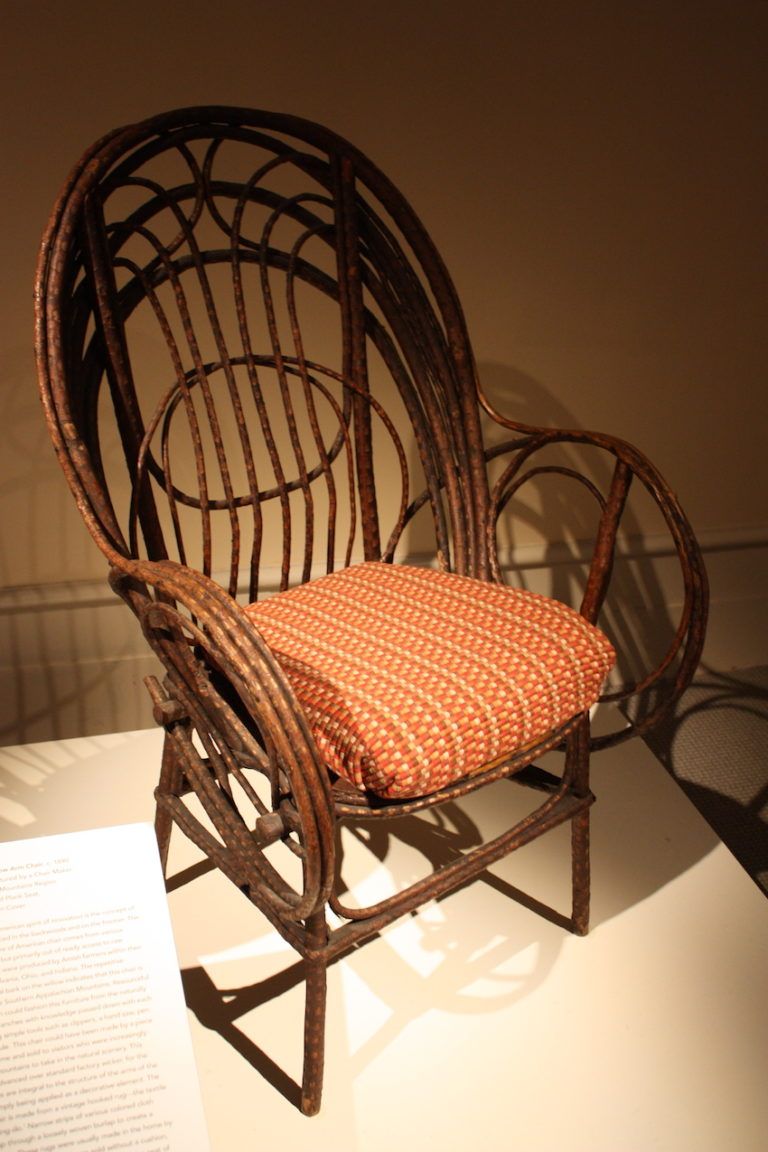
 Appalaichan bent willow armchair is a proficient exempt of the american pioneering spirit of making use of what is at hand. The long flexible follow branches are easy to manipulate into shape and crafted with simple tools. The methods and techniques were often passed downwardly through the generations.
 View in gallery
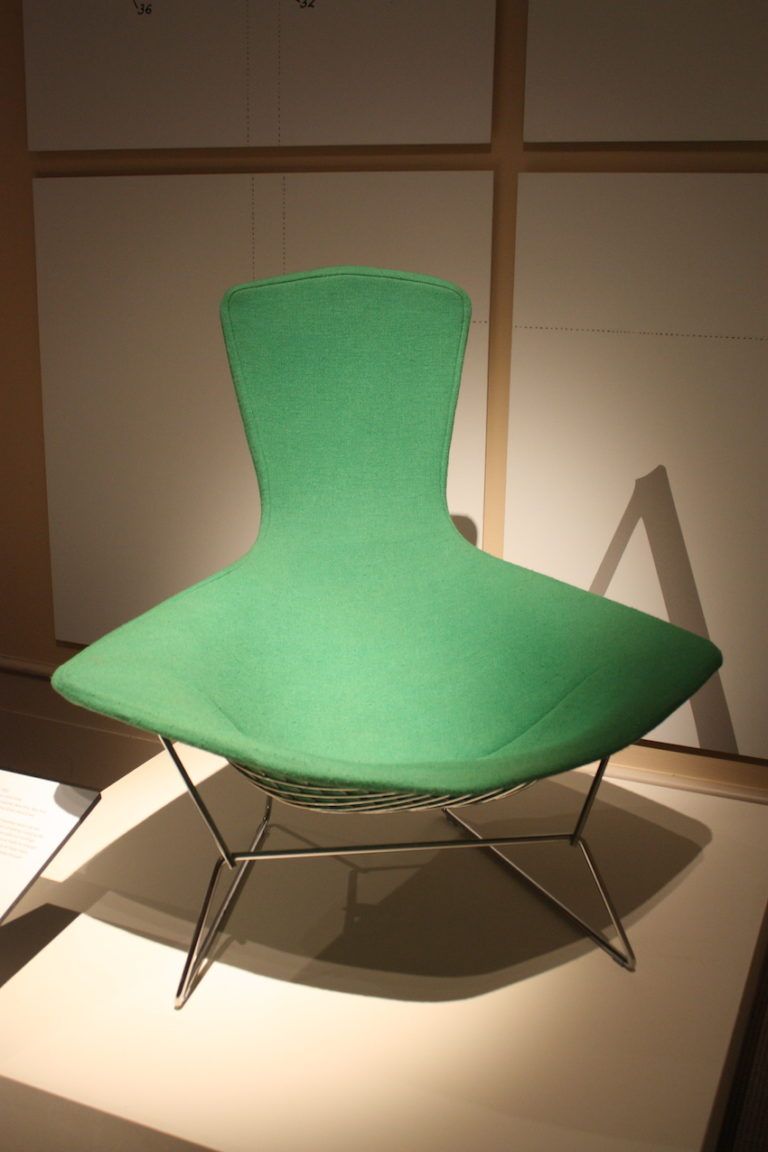
 Piece of furniture icon Harry Bertoia created this chair, among others, after experimenting with bent metal rods. This is his Bird Lounge Chair, manufactured past Knoll.
 View in gallery
 This stately chair is Thomas Warren'due south Centripedal Leap Armchair, created in 1850. The Victorians' were always looking for ways to be comfortable when seated, and this chair's construction achieved that. The chair tin can rotate, moved laterally and vertically. Warren received a patent for the springs in his chair, besides every bit a design for railroad car seat backs.
 View in gallery
 Vivian Beer's 2002 "Current" chair "pushes the boundaries betwixt art and craft, between utilitarian object and sculpture." Commenting on her chair design, the arts said that she wanted a chair that looked similar information technology had be cut and crushed from a single piece of metal.
 View in gallery
 Today, Frank Gehry is best known for his astonishing architectural designs, just it was actually a line if furniture crafted from corrugated cardboard that launched him into wide attention. Inspired by the material used to make architectural models, Gehry's experiment yielded 17 designs and a patent for his work. While they were very successful, he stopped making them because it distracted him from his architecture work.
 View in gallery
 The Iconic bench by Laurie Beckerman is fabricated from 18 layers of Baltic Birch plywood that are sandwiched together and finished to exquisite smoothness. The surface is then coated Italian acrylic.
 View in gallery
 When Frank Lloyd Wright designed the Johnson Wax corporate headquarters in 1938, he also designed all the piece of furniture. This patented chair design started out equally a three-legged chair, but it is said Wright it changed to four legs later on he toppled over in the original design.
 View in gallery
 While we are used to seeing rattan used in chairs these days, dorsum in 1885 when this was designed, the materials was new to the United states. Boston grocer Cyrus Wakefield noted the fabric, which was used to secure cargo on ships and thrown out o the docks. He started experimenting with in in making furniture and created the wakefield Rattan Co.
 View in gallery
  View in gallery
 One of the 20th century's near celebrated chair designs is the Eames' LCW (Lounge Chair Wood). Molding plywood with heat and pressure allowed them to create their iconic designs with bent woods. It was produced by the Herman Miller Visitor.
 View in gallery
 George Nelson's MAF (Medium Arm Fiberglass) Chair was created in 1965. Nelson served as blueprint manager for Herman Miller ad collaborated with some of the greatest names in blueprint, including Noguchi, Eames and Bertoia. He intended for the legs of this blueprint to exist universally applicable and able to exist assembled with merely a screwdriver.
 View in gallery
 A Plank Back Chair by Charles Limbert is a great example of the Arts and Crafts Movement, which took root in the 19th Century every bit a reaction to the Victorian era. Information technology is fabricated from fumed oak, leather and brass.
 View in gallery
 This Rocking Armchair is a Shaker piece from effectually 1840. The simple, undecorated and highly functional piece is typical of the Shaker style, which afterward inspired modernist designers in america and Scandinavia. Shakers viewed work equally worship and the industriousness led to the development of items such as clothespins, the circular saw, and garden seeds packaged in paper.
 View in gallery
 James Beebe and Company produced the Rustic Twig Demote from cast iron around 1855. The style was indicative of the Picturesque Garden Movement in America. The visitor that produced this bench also made the cast iron sections of the washed on the U.S. Capitol building.
 View in gallery
 These chair designs span 200 years, yet many of their features and characteristics are withal popular today. Whether modernist and spare or fanciful rattan designs, they all offering inspiration for many home decor styles. Perchance y'all already have some vintage pieces in your home, but if not, variations of these chairs tin can be found in design shops across the world.
Source: https://www.homedit.com/iconic-chair-design-for-tasteful-home-decor/
0 Response to "Iconic chairs from 200 years of American Design"
Enviar um comentário